Management at Machine Speed
The Three Disciplines That Matter Now

Fourth in a series that began with “Your Management Model Is the New Bottleneck,” continued with “Management Is Losing Its Meaning,” and “Beyond Productivity: Who Owns Your Skills?”
Across the industry, from boardrooms to engineering all-hands, the same question is surfacing: where is the AI ROI?
Companies are spending millions of dollars to equip their engineers with the best and most advanced AI tools. Many billions of tokens are being consumed every month. The cost of running software is increasing fast. This time, the investment is not a technology expense. It is a workforce expense. Unlike every previous technology cycle, AI is not competing for the IT budget. It is competing with the labor budget, replacing and augmenting what people do. But the returns are not showing up where leadership expects them: in faster delivery, higher quality, competitive advantage, or increased revenue. The costs are rising. The value is not rising with them. The dashboards show activity. They do not show value. The value is there. But it lives in the ghost notes, the dimensions that current metrics were never designed to capture, and that leaders do not yet know to ask about.
Here is what the dashboards also do not show. On the ground, something very different is happening. Teams are energized. Developers are shipping features that used to take weeks in a matter of hours. Engineers are running multiple agent threads in parallel, reviving long-deferred projects, tackling work they never had the capacity for. Senior technology leaders are personally building prototypes with tools like Claude Code and posting about the experience with visible excitement. The energy is real. I see it in every organization I work with.
These two signals seem contradictory. Missing ROI at the top. Genuine excitement at the bottom. They are not contradictory. They are two symptoms of the same root cause.
Management has not evolved to match the technology.
The ROI will come. But not while organizations are still in the infatuation phase. Today, companies measure their engineers’ token consumption internally. Cross-industry leaderboards compare how much AI organizations consume. Jensen Huang said at GTC: “If that $500,000 engineer did not consume at least $250,000 worth of tokens, I am going to be deeply alarmed.” But consumption is not value. The ROI will show when organizations move from infatuation to industrialization: when the processes, methods, structures, and management are in place to leverage these new capabilities, not just deploy them. This article is about that evolution.
The Adrenaline Phase
A recent study from Berkeley Haas, published in HBR, found that AI tools do not reduce work. They consistently intensify it. Employees worked at a faster pace, took on a broader scope of tasks, and extended work into more hours of the day, often without being asked to do so. They did this because the tools created a sense of momentum, a feeling of having a “partner” that could help them power through their workload.
That momentum is real. It is also unsustainable. But not immediately. The cognitive cost accumulates over weeks and months, invisible until it surfaces as errors, disengagement, or resignation. This is precisely why management matters. By the time the symptoms are visible, the damage is already done. Someone has to be watching before the crash, not after it.
Separate research from BCG and UC Riverside identified what they call “AI brain fry”: cognitive fatigue that occurs when AI use exceeds a person’s ability to process the volume of information and decisions it generates. It produces mental fog, difficulty focusing, slower decision-making, and information overload. 14% of AI-using employees reported experiencing it. Among those who did, intent to leave rose by nearly 10%. And a 2026 workplace study found that the average focused work session has dropped to just 13 minutes, down 9% in two years.
There is a positive signal here too. For years, employee engagement has been in continuous decline. AI tools have the potential to reverse this by absorbing the repetitive work that drains motivation and freeing people to focus on work that energizes them. That is a real and valuable shift. But without deliberate management, the same tools that re-engage people by removing drudge work will overload them by increasing the pace and volume of everything else. The upside and the downside come from the same source. The question is whether anyone is governing the balance.
The executives communicating their AI excitement in all-hands meetings and industry events are not wrong about the technology. They are wrong about what their personal experience predicts for the organization. A senior leader spending a Saturday afternoon building a prototype with an AI coding assistant is having a personal experience. It tells them nothing about what happens when 500 people operate at that intensity for twelve months. One person’s exhilaration on a Saturday is not an organizational strategy. But it becomes one when that leader walks into Monday’s all-hands and broadcasts the excitement as the new standard. Every manager down the line reads the signal: speed is the expectation. Anyone raising concerns about sustainability is swimming against the current.
The adrenaline phase looks like transformation. It is the precursor to a crash. And the organizations that mistake one for the other will lose their best people first.
Why Management Was Never Ready For This
Before AI arrived, management was already running on fumes.
Gallup has spent decades documenting the failure. Most companies promote workers into management because of tenure or performance in a non-management role, not because they have management talent. Only one in ten people possess the inherent ability to manage. The result: organizations fail twice. They lose their best individual contributor. They gain a bad manager. This costs the U.S. economy between $319 and $398 billion annually.
But the failure goes deeper than selection. Most managers never formally learn what management is. There is no structured curriculum, no defined competency model, no progression framework. They learn on the job, which means they imitate. They imitate their own manager, who was also promoted without training. They draw from articles, from cultural mythology about what leadership looks like, from MBA programs still teaching frameworks built for a world that no longer exists. The entire management training infrastructure, from universities to corporate leadership programs, remains ill-equipped for this age. The signal degrades with every copy. By the time it reaches today’s manager, the operating model is a patchwork of inherited habits, half-remembered advice, and instincts that may or may not apply.
Management today consists of more than a dozen distinct disciplines. Most managers could not name them. Most organizations have never made them explicit. You cannot transform what you have not defined.
Some organizations sense that something is missing. Across the technology industry, companies are creating new roles like AI Transformation Lead, charged with driving adoption and accelerating speed. But these roles are aimed at the tool side of the equation, not the management side. They are not equipped to handle the organizational and management transformation that the technology demands. It is another instance of solving for the machine while ignoring the human.
And now the speed has changed by orders of magnitude.
From Road Speed to Race Speed
Here is the metaphor that clarifies what is happening.
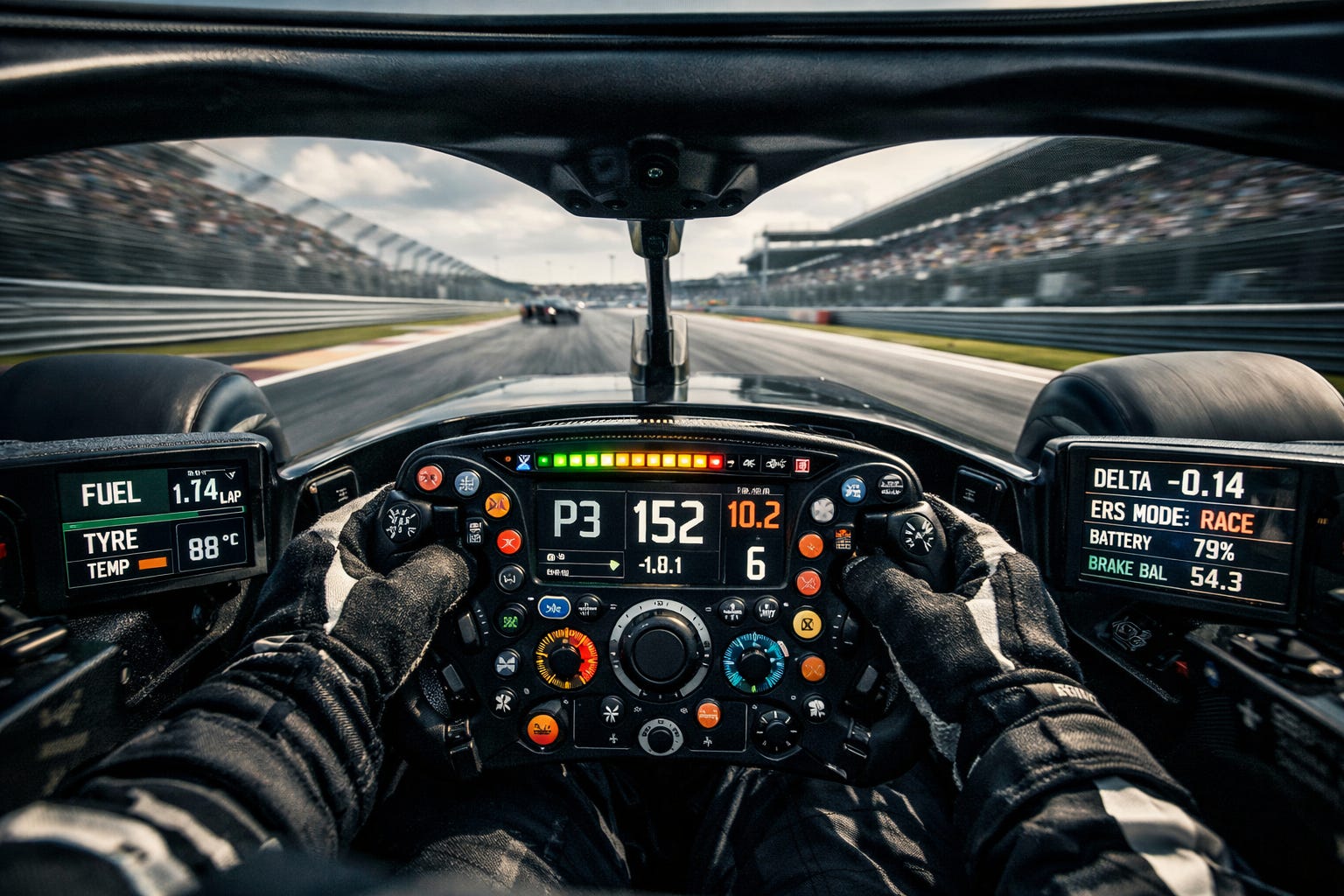
An F1 car and a regular car both put a human behind the wheel of a machine. But the similarity ends there. A regular car takes you from one place to another. An F1 race is circular. The driver ends exactly where they started. The point is not the destination. It is sustained performance under extreme conditions, lap after lap, at intensities where the human body becomes the limiting factor, not the machine. The car can corner faster than the driver’s neck can sustain. It can brake harder than the driver’s cardiovascular system can handle. The entire engineering effort around an F1 team is not about making the car faster. It is about managing the human-machine interface at extreme intensity.
The agentic era is the moment when work shifted from driving to racing. From linear delivery (start a project, execute, ship) to continuous cycles of production at machine speed, where the work never stops and the human must sustain performance across every lap. The machine can go faster. The question is whether the human can last.
In F1, this is solved by design. The race engineer filters information so the driver’s cognitive bandwidth is protected. The team governs pace, telling the driver when to push and when to conserve, because maximum intensity for the full race distance destroys the tires. The car is designed around the driver’s constraints, not the other way around. And the driver must maintain fundamental skills even as the car’s systems take over more functions, because a driver who loses feel for the tires or the braking points becomes dangerous.
Most organizations are doing the opposite. They are asking humans to match the machine’s pace. That is the equivalent of running qualifying laps for 58 laps. It works for the first few. Then the tires degrade, the brakes overheat, and either the car fails or the driver makes a catastrophic error. Even with the best race management, F1 drivers sometimes finish so physically depleted that they cannot get out of the car without assistance. These are the fittest athletes in motorsport, trained specifically for this intensity. Your engineers are not. And unlike the driver, they do not get a two-week break between races. They do it again Monday morning.
The fans, by the way, recently pushed back against F1 going electric. They want the roaring sound of the engines. Organizations have their own version of this: the attachment to standup meetings, sprint reviews, performance ratings, and org charts with reporting lines. These are the roaring engines. They feel like management. They are not where the performance comes from anymore.
The Three Disciplines That Matter Now
Most of the traditional management disciplines are being absorbed by agents. Task management, resource allocation, budget tracking, schedule management, routine communications, process execution. Agents do these well and will do them better. This is not a prediction. It is already happening. As one reader commented on my second article: “Three months ago I stopped using Jira. I just work with an agent and the code directly. No need for a middleman. Not a SaaS middleman, and soon, no human middlemen.”
What remains is what agents cannot do. Three disciplines that are not just surviving the transition but are becoming the entire point of management.
Protecting cognition. The old manager protected budgets, timelines, and deliverables. The new manager protects the human brain. When your team is running multiple agent threads, producing output at machine speed, and experiencing the cognitive load that research now documents as brain fry, the manager’s primary job becomes sustaining human performance. This operates at two levels. At the individual level, it means monitoring cognitive load, governing the number of parallel workstreams, and creating space for deep focus in a world where the average focused session lasts thirteen minutes. At the team level, it means preserving coherence. Each person is in their own human-agent loop. Shared context evaporates when everyone is producing at a pace that makes it impossible to track what teammates are doing. The manager creates the synchronization points that keep the team functioning as a unit rather than fragmenting into parallel streams.
Governing tempo. Work now moves at machine speed. The old constraint was scarcity: not enough people, not enough time, so you prioritize ruthlessly. The new constraint is abundance. Agents can do everything. The question becomes what should we not do. The manager becomes a constraint by design, not by default. They are the person who says: we could pursue twenty initiatives this cycle because the agents can handle the execution, but we are doing six because that is what the humans can meaningfully specify, review, and learn from. This is the F1 race engineer telling the driver to conserve on lap twelve. Not because the car cannot go faster. Because the race is won over fifty-eight laps, not five. Organizations that push human hours to match machine speed, the 996 culture now spreading in Silicon Valley, are running qualifying laps for the entire race distance. The research is clear on where this ends: burnout, turnover, degraded decision-making, and the very brain fry that erodes the quality of human judgment that AI depends on.
Governing skills. In my previous article, I argued that AI extracts skills through deskilling and never-skilling. That extraction happens in real time, inside the daily work. Every time an employee delegates a task to an agent without understanding what the agent did, a skill degrades. Every junior hire who never learns the fundamentals because agents handle them is a never-skilling casualty. This is not something HR can manage with quarterly training programs. It happens in every task, every day. The manager’s role is not to approve each delegation decision, but to set the framework that governs them: which capabilities the team must maintain, which skills are strategic assets, and where human practice is non-negotiable. Without that framework, the default is to delegate everything, and the skills quietly disappear. At the team level, this means governing the collective skill portfolio. If one person’s judgment in a critical domain erodes because they have delegated too much to agents, the entire team is exposed. Skill governance is an operational management responsibility now, not an HR function.
These three disciplines are not independent. They form a reinforcing system. If you fail to protect cognition, the quality of specification and review degrades. If you fail to govern tempo, cognitive overload accelerates. If you fail to govern skills, the humans lose the ability to direct agents effectively, which means more errors, more rework, and more cognitive load to manage the consequences. The loop tightens until something breaks.
And quality, the outcome that every organization cares about, lives inside this system. Specification quality, verification rigor, and human judgment are all products of cognitive health, sustainable pace, and maintained skills. You do not manage quality by inspecting outputs anymore. You manage quality by managing the humans who direct and evaluate the agents.
The ROI organizations are looking for will not come from the tools. It will come from transforming the management, the processes, and the roles that govern how those tools are used.
Beyond the Team
Everything I have described so far operates at the team level: one manager, one team, managing the human-machine interface. But the challenge does not stop there. Organizations will need to manage synchronization at four nested levels: the individual orchestrating multiple agents, the team integrating output across multiple human-agent loops, the organization governing all of this through its own multi-agent architecture, and ultimately the customer interface where your agents interact with your customers’ agents. Most organizations have barely addressed the first level. The third and fourth are coming faster than anyone is prepared for.
This is why the CEO cannot see the ROI. The investment went into the machine side of the equation. Nobody invested in the human-machine interface. That is like buying an F1 car and skipping the driver program, the race engineers, and the telemetry systems. The car is fast. The results are terrible. And the board is asking why the car is not winning races.
The Fork in the Road
Organizations will go one of two directions from here.
Some will push humans to keep pace with agents. More hours, more intensity, more parallel workstreams. They will celebrate the adrenaline phase and optimize for the metrics it produces. Their best people will burn out first because the best people are the ones pushing hardest. Then the juniors will hollow out because nobody invested in their skill development. Within eighteen months, these organizations will have fast machines and degraded humans, and they will wonder what happened to the AI returns they were promised.
Others will recognize that the agentic era requires a new kind of management. Not management with AI bolted on. Not AI-driven management with humans holding on. A deliberately designed system where the human and machine elements are integrated, each doing what they do best, with the manager governing the interface. These organizations will invest in their managers the way F1 teams invest in their drivers and race engineers. They will define what management actually consists of, probably for the first time. They will build structured development paths that equip managers for the three disciplines that matter: cognition, tempo, and skills.
The technology is extraordinary. The machine side of the equation is solved and getting better every quarter. The human-machine interface is where the value is trapped. Management is the key that unlocks it.
The question is not whether your organization will adopt AI. That is already happening. The question is whether your management model will evolve fast enough to turn that adoption into value.
The race has started. The car is on the track. Who is engineering the driver’s seat?
Love this. Fully agree about the management skills that are needed. Protecting cognition in this era is challenging, and governing skills and load are critical to maintain high functioning teams over time.