When the Executive Stops Managing
Management was built on achieving outcomes through people. What happens when that is no longer required?

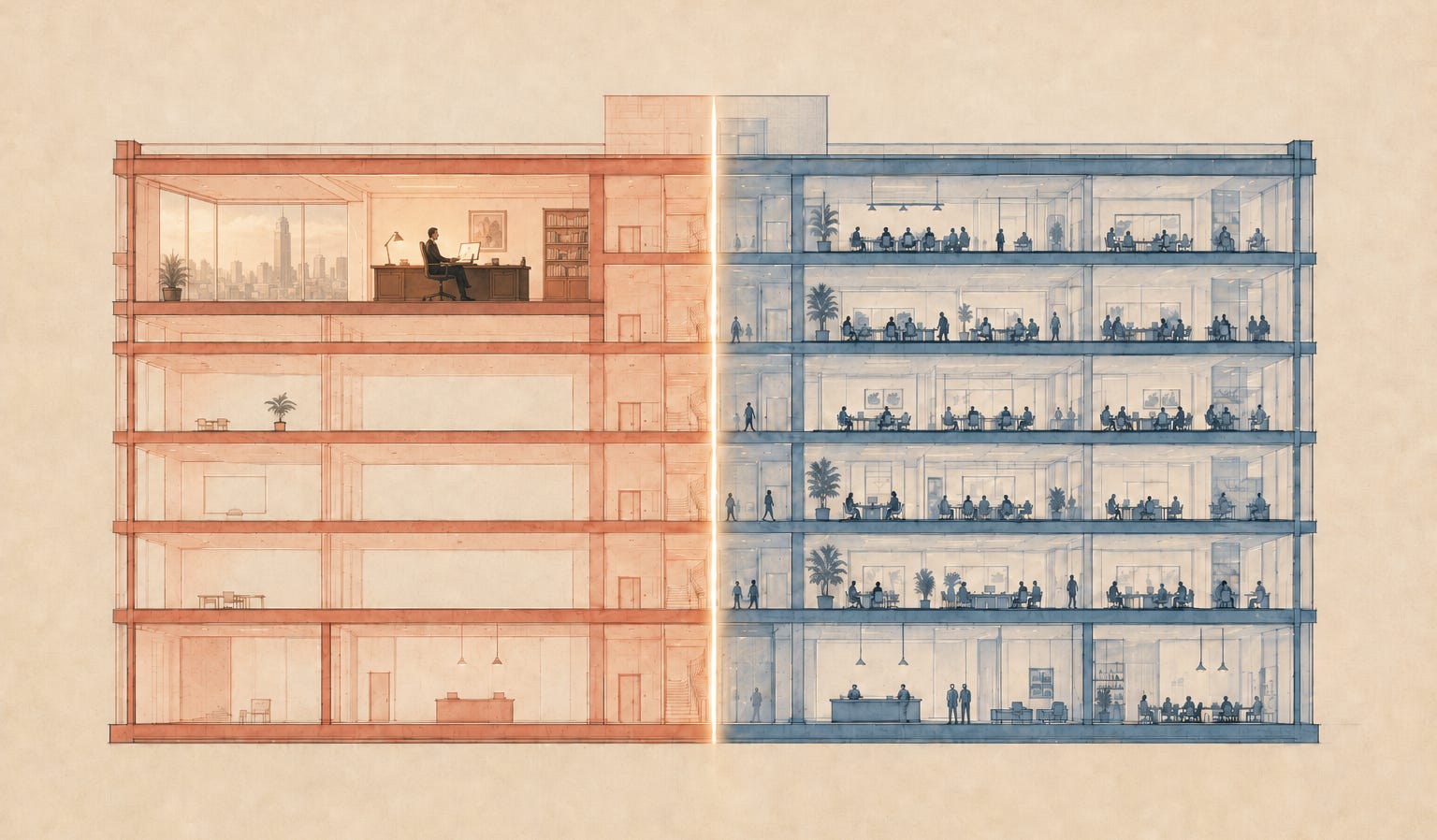
Imagine a ship in the seventeenth century, sailing toward a coastline none of the crew has seen before. The captain stands on the deck. A lookout sits in the crow’s nest, high above. The work between them is coordination. The lookout has altitude. The captain has authority. Neither alone can navigate the ship. The lookout sees the horizon and calls down what they see. The captain interprets the call, judges its meaning, and decides the response. The system works because no single person has both the vantage and the command.
Then the telescope arrives.
The instrument does not give the lookout a better view. It gives the captain the lookout’s view directly. The captain can now see the horizon, name the ship on it, judge its course, and decide the response without intermediation. The crow’s nest does not disappear. Navigation still depends on many instruments and many hands. But the telescope changed one thing: for the work the captain chose to do directly, the lookout’s role had become optional.
The technology was given to the captain, not the crew. This is not an accident of who could afford it. It is the structure of the change. Power is distributed when capability has to be distributed. When capability concentrates, power concentrates with it. The telescope did not democratize navigation. It centralized it.
Something analogous is happening now, inside organizations. A new instrument has arrived. The agent. It helps the engineer write code faster. It also gives the executive a capability the executive did not have before: the ability to reach the work directly, without the layers that used to mediate between intent and outcome. The engineer’s role is not diminished. What is new is that the executive, for the first time in a century, can hold both vision and execution in the same hands.
The previous article in this series zoomed out to see the corporation being reshaped by technique, by the moving boundary of the firm, by forces larger than any one organization. This article zooms in. The agentic executive is one of the most visible shapes the reshaping is taking inside the firm. They are not the cause of the change. They are the trial period made visible. The organization that built them is being tested, in real time, against the question of whether it can transform into something the old language does not yet describe. The agentic executive matters not because senior leaders are building again, but because their building reveals that the premise management was built on, achieving outcomes through people, is no longer structurally guaranteed.
The End of the Lean Startup Age
The lean startup was a response to two constraints, not one.
The first was uncertainty. Eric Ries defined his framework precisely: a startup operates under conditions of extreme uncertainty. The builder does not yet know who the customer is or what the product should be. Lean is the disciplined response to that not-knowing. Release a slice. Learn from the market. Iterate. Converge toward a product whose final shape was unknown at the start.
The second constraint was execution. Ries did not need to name it because in his world it was a given. Building anything required people, time, and capital, all of them scarce. Even if a founder held the full vision, they could not build it alone. They needed engineers, designers, testers, managers. The organization existed because the work exceeded what any single person could execute. The concept that best reveals this hidden constraint is the MVP itself. Minimum viable product. The word “minimum” is not just a learning strategy. It is a resource constraint. You build the minimum because you cannot afford to build the maximum. Ries designed the MVP to enable learning with the least amount of effort and the least amount of development time. That design makes sense only in a world where effort and development time are scarce. Lean assumed both constraints simultaneously: you do not know exactly what to build, and you do not have the resources to build everything and see what works.
A different construction philosophy has always existed. Hold the entire vision in advance. Design the architecture, the strategy, the roadmap. Release and refine toward a known endpoint. Aircraft are designed this way. Operating systems are architected this way. Iteration is convergence, not exploration. The endpoint is in sight from the start.
This philosophy required two things at once. A person who could see the full vision. And an execution capacity that could match it. For two centuries of industrial work, no individual had both. Vision lived at the top of organizations. Execution lived distributed across hundreds or thousands of hands. The translation between them was the entire job of the middle.
Both constraints are now lifting for a specific class of builder. Agents close the gap between intent and working artifact. Senior leaders who hold the full product vision, who have spent decades building the judgment to know what the product should be, now have execution capacity to match. They are not operating under Ries’s conditions of extreme uncertainty. And they are no longer bound by execution scarcity.
Two figures emerge in the post-lean age. The solopreneur outside the firm. Pieter Levels, Maor Shlomo, Ben Broca. People building meaningful businesses alone, with agents instead of teams. They have been written about extensively. The figure inside the firm has not received the same attention. That is the subject of this article.
The Phenomenon, Named
I spoke recently with a senior executive who described the experience in a way I have not been able to improve on. He said it was like being a great soccer player who had become a coach, and now, with new capabilities, could step back onto the field and play again. Better than he ever played as a young man.
The metaphor is worth holding onto. This executive spent decades building systems, shipping products, developing the judgment that comes only from years of doing the work. Then he was promoted. Into management. Into leadership. Into the role where outcomes happen through other people. The work he loved, the craft he had mastered, moved to the hands of others. He directed. He reviewed. He approved. He no longer played.
Now the agent gives him the field back. Not in a diminished form. In a better form. He can see the architecture of the entire product because he spent twenty years learning it. He can specify what needs to be built because he holds the full context: the company strategy, the competitive landscape, the technology stack, the customer needs, the conversations with other executives that shaped the direction. No one else in the organization holds all of these at once. And the agent can produce certain classes of working artifacts faster than the team structure around him could absorb, prioritize, and deliver them. Vision and execution, reunited in the same person.
He is not alone. Job van der Voort, CEO of Remote, a global HR platform valued at more than $3 billion, builds features for his own product. He goes through the standard code review process like any engineer on his team. He wanted a feature. He did not file a request. He built it. Moshe Bar, CEO of Codenotary, built a 140,000-line production application using Claude. He is not a programmer. He personally edited roughly ten lines of code. His estimate of the conventional cost: three or four senior developers at $400K to $500K each. Wade Foster, CEO of Zapier, built a personal AI chief of staff in Cursor. Woodson Martin, CEO of OutSystems, described the impulse behind his own experiment in blunt terms: “I was tired of explaining it to somebody who was supposed to build it for me.”
An earlier article in this series called the broader pattern the infatuation phase: the organizational stage where the capability itself becomes the object of attention. The agentic executive is the infatuation phase at its most concentrated. Not the developer in love with running parallel agent threads. The executive in love with playing the game again.
There is a name for this figure. The agentic executive. A senior leader inside an organization large enough that there is structurally a layer between them and the work, who chooses to bypass that layer using agents. Three conditions define the pattern. Authority over the organization. An organization built to do the work. And the choice to do it themselves instead.
The solopreneur fails the second condition. The CEO of a five-person company arguably fails the second. The CVP, the SVP, the CTO, the CEO of a large enterprise meet all three.
These are not personality cases. They are structural ones. The capability has been distributed asymmetrically, and the executives experiencing the return of the field are responding to something real. As one of them told me: I have everything in my head already. Why would I spend months explaining it to people who do not have the context, when I can build it in a weekend?
What Is Collapsing
Start with what management is. Not what it does. What it is.
The discipline of management rests on a premise so foundational that it forgot it was a premise. Management is the practice of achieving outcomes through other people. Not through doing the work yourself. Not through any available means. Through people. This is what made management a discipline distinct from craft. The craftsman achieves outcomes through their own hands. The manager achieves outcomes by directing the hands of others. The entire discipline, its language, its structures, its hierarchies, its training programs, exists because human work required coordination, motivation, and judgment exercised across many people.
The pieces of management that have been dissolving in the agentic age, process ownership, signal collection, delegation, measurement, are not independent failures. They hang from the same through-line. The through-people premise. Remove it and the pieces have nothing to hold them together.
The agentic executive has removed the people from the through-line. Not from the organization. From the through-line. The employees are still there. The org chart is still there. The reporting lines are still there. But for the work the executive chose to do directly, the structural relationship that made people the means to the executive’s ends has changed. The executive now has a path from vision to outcome that does not pass through them.
If management is the practice of achieving outcomes through people, then the executive who achieves outcomes through agents is not managing. They are doing something else. Something we do not have a word for yet. The definition does not stretch to cover it. It breaks.
The break is not just felt. It has a structure.
Between the executive and the work, organizations built a layer of management. That layer exists because direct coordination does not scale. As organizations grow, the person at the top cannot reach the work alone. Managers translate strategy into operations, break vision into tasks, and mediate between intent and execution. This is how large organizations have functioned for over a century. The agentic executive can now reach the work directly, without that mediation. For the work the executive chose to do themselves, the layer between them and the outcome has become optional.
Frederick Taylor formalized the separation that made modern management necessary. Conception belongs to management. Execution belongs to workers. The entire bureaucratic apparatus of the twentieth century was built on this division. The agentic executive un-separates conception and execution. But only at the top. The senior leader recombines them in their own person. For everyone else in the organization, the separation persists. Conception still flows downward. Execution still happens below. Modern organizations softened this separation with agile teams, product ownership, engineering autonomy, and senior IC structures, but they did not erase it. Taylor still governs below. The executive has exempted themselves.
This is an asymmetric reversal of the foundational separation. Not a dissolution. A personal exemption. The executive becomes the person for whom the recombination of conception and execution is backed by the full authority of the organization.
Ronald Coase argued in 1937 that firms exist because coordinating work through markets has transaction costs. Inside the firm, hierarchy replaces the market as the coordination mechanism because it is cheaper. The firm’s boundary sits where internal coordination costs and external market costs meet.
The same logic applies inside the firm. The modern executive always had private context: private judgment, private networks, private intuition. What they never had was private execution capacity. Execution required the organization. Agents change that. They turn executive context into executable output without passing through the organization’s interpretive layers.
The agent does not move the boundary of the firm outward. It folds a new boundary inward. The executive’s transaction cost with their own agent is now lower than their transaction cost with their own organization. The hierarchy competes with a coordination mechanism that is faster, cheaper, and available at any hour. On one side of this new boundary, the executive and the agent. On the other, the rest of the organization. The firm is intact externally. Internally, it has a seam.
What the Organization Receives
The executive ships a feature. Not as a side project. Not as a weekend experiment. As part of how they now work. The building has become integrated into their regular operating rhythm, alongside the strategy meetings, the cross-functional reviews, the one-on-ones. The formal role has not been abandoned. It has been compressed to make room for the work the executive now does directly.
What does their organization receive?
The question is not whether senior leaders should build. They should. The distance between leadership and the artifact has grown too large in many organizations. Executive building can clarify strategy, expose bad process, raise ambition, and reconnect leaders to the reality of what their teams produce. The question is whether what the executive builds returns to the organization as shared context or bypasses the organization as private execution. The first strengthens the firm. The second hollows it out. The line between them is not always visible, and most organizations are not drawing it.
Start with the management layer between the executive and the work. It existed to mediate between strategy and operations. The agentic executive demonstrates, by their behavior, that they no longer need that mediation for some classes of work. The layer did not lose its job. It lost a specific function. Which classes of work the executive will keep mediating, and which they will increasingly do directly, has not been settled by anyone.
There is a measurement problem here. Organizations have spent decades building systems to track executive performance, team velocity, delivery timelines, product quality. None of these systems measure what happens when the executive steps outside the system itself. The organization is winning the metrics and losing the mission. The executive shipping fast registers as success on every dashboard that exists. The cost, the organization’s coherence, its shared context, its ability to function as a unit, is not on any dashboard that exists.
At the leading technology firms, the share of AI-generated code has grown rapidly. At one major firm, it moved from a quarter to more than 75% in under two years. The structural conditions for the agentic executive are not confined to a few exceptional leaders. They are present in every major technology firm. The phenomenon will scale. And the organizational questions it raises will scale with it.
One of those questions concerns the pipeline. Think about how today’s senior leaders became senior leaders. They built products through teams. They learned to translate vision into specifications that others could execute. They developed judgment through years of navigating the gap between what they wanted and what the organization produced. That gap was not inefficiency. It was the training ground. If the agentic executive skips the gap, the training ground disappears. The next generation of leaders does not have a path to the same judgment, because the path ran through the very process the executive no longer needs.
There is a deeper question underneath this one. The infatuation phase, the organizational stage where the capability itself becomes the object of attention, has a natural arc. It is a precursor, not a destination. Whether the agentic executive pattern follows the same arc, a phase that matures into something sustainable, or whether it represents a permanent reshaping of the executive role, is not yet known. The answer depends on whether organizations design for it deliberately or let the pattern run on its own logic.
The Diagnosis
Some teams see it happening. The executive builds something in days that the team had been planning for months. Some react with possibility. If the executive can do this, so can I. The behavior cascades. The agentic executive becomes a proof of concept for the organization.
Others see the same thing and feel the weight of it. The executive did not ask the team to build it. Did not give them the opportunity. The team learned about the result after it existed. The message, intended or not: I did not need you for this. Between peers, that demonstration is inspiration. From the person who decides whether you keep your role, it carries a different weight.
But not all of it is visible. In some cases the executive builds and the team does not know. The team continues working on something the executive has already built or decided to build differently. The standups continue. The planning meetings continue. The status updates continue. The structure looks intact. It is not. The team’s work may be rendered irrelevant without them ever knowing it was being duplicated in parallel.
The pattern does not stop at the individual executive. The solo agentic executive holds vision and execution alone. But executives inside the same division share the same strategic context. They see the same customers, the same competitive landscape, the same gaps in the product. They have the same agent capability. The natural next step is that they team up. The leadership layer of a division forms its own execution unit, building together with agents while the division underneath continues to operate as usual. Call it the super-team. The formal organization persists. Inside it, a parallel organization has begun to form. This is not a redesign. Nobody announced it. Nobody approved it. It is the trial from within. The conventional enterprise, testing whether its leadership can operate as something new while the old structure is still running.
The super-team raises a different risk than the solo executive. A single executive bypassing a team is a morale problem. The leadership layer collectively bypassing the organization it leads is a legitimacy problem. The division was staffed, budgeted, and structured on the assumption that it is the vehicle for the division’s work. When the leadership layer becomes its own vehicle, the division’s reason for existing is no longer self-evident. The people inside it have not been told that the premise has changed. They are operating under a contract that the leadership layer has quietly renegotiated with itself.
Four patterns. The visible and inspiring. The visible and heavy. The hidden. The collective. Each one is a different expression of the same structural shift. The through-people premise, the foundation that made management a discipline, is being sidestepped at the top. Sometimes openly. Sometimes invisibly. Sometimes by one leader. Sometimes by the leadership layer as a whole.
I have been using a phrase in conversations with leaders that tends to land hard. Managerial violence. Not violence by the person. The person may be acting with the best intentions. Violence in the structural effect on the people who are being bypassed, visibly or invisibly, by the leaders who were supposed to achieve outcomes through them. Managerial bypass would describe the mechanism. Managerial violence describes the experience on the receiving end. I am not certain it is the right term. But I have not found a better one, and the reaction it provokes tells me it is touching something real.
The executives drawn into this pattern are not choosing it in any deep sense. Jacques Ellul argued that technique, the logic of efficiency, selects for itself regardless of human preference. The agentic executive may be what technique selects for inside the conventional enterprise. The leaders most committed to their organizations are the ones most likely to find themselves here. They build because they can see the whole, because the agent is faster than the translation, and because the gap between their vision and the organization’s output has always frustrated them. The frustration was always there. The capability to act on it is new.
The Naming Problem
The agentic executive. The super-team. Two figures that did not exist a year ago. Both emerging inside conventional enterprises, not in startups, not in greenfield organizations, but inside firms whose structures, contracts, and expectations were built for the through-people model of management.
When the first automobiles appeared, people called them horseless carriages, defining the new thing by what it lacked rather than what it was. The word automobile came later. Whatever these executives are doing when they bypass their own organizations and build with agents, it is not management. Management is the practice of achieving outcomes through people. This is something else. It is not craft either. The executive is not simply doing the work. They are doing it from a position of authority over an organization that was built to do it for them.
A previous article in this series described the conventional enterprise being reshaped by forces larger than any single organization. The agentic executive and the super-team are how that reshaping becomes visible from the inside. They are not the endpoint. They are the trial. The conventional enterprise is testing, through these figures, whether it can transform into something that might be called the agentic-native company. A firm designed from the start for the world these executives are already operating in.
Whether that transformation succeeds depends on whether organizations design for it deliberately or let the pattern run on its own logic. The answers will not come from theory. They will come from the organizations living through it right now.